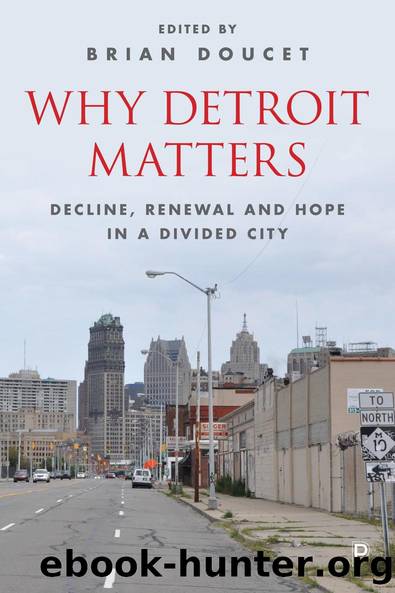
Why Detroit Matters by Doucet Brian
Author:Doucet, Brian [Doucet, Brian]
Language: eng
Format: epub
ISBN: 9781447327905
Barnesnoble:
Publisher: Policy Press
Published: 2017-04-06T00:00:00+00:00
Section Two
Practices from Detroit
NINE
Evolution of municipal government in Detroit
John Gallagher
The second section of the book focuses on new practices found in Detroit. It features chapters written by writers who are either engaged in these new activities, or by insightful commentators who have witnessed and written about the city for a long period of time. John Gallagher fits into this latter category; his close to 30 years of writing about economic and urban development for the Detroit Free Press puts him in a unique position to assess many of todayâs new social and spatial practices. The trend that he focuses on in this chapter is the spinning off of pieces of Detroitâs government into publicâprivate partnerships, non-profits, or other forms of governance outside the City of Detroitâs direct control. Gallagher takes an optimistic, if cautious, assessment of the shift in places such as Eastern Market, Cobo Center, or Belle Isle away from city control. His arguments are rooted in the structural and historic decline of the city, as illustrated in earlier chapters by George Galster and Ren Farley. Gallagher describes how, amid rapid population and economic decline, the city became unable to provide the funding to support the institutions, parks, and amenities within its borders. While he acknowledges the improvements that such partnerships bring, he is also aware of the tensions, many of them racial in origin, which have been produced or exacerbated because of this.
Gallagher outlines several factors that contribute to the more successful operation of these places, including access to different sources of funding and dedicated management (points that are reiterated in the conversation with Dan Carmody, President of the Eastern Market Corporation, in Chapter Nineteen). However, as others have noted in this book (see Victor, Chapter Twenty), Gallagher also reminds us that we should not assume that these transformations represent the only story taking place in Detroit and that there is a growing gap between the cityâs economic and geographic core (where most of these spin-offs take place) and its periphery. There are many caveats we need to be cautious of, including the fact that many of these spin-offs took place while Detroit was under an emergency manager who was not democratically elected by the people. The idea that these pieces of Detroit were âtakenâ away from its citizens will be picked up further in the conversations with Sandra Hines (Chapter Seventeen) and Yusef Bunchy Shakur (Chapter Twenty-four). That Gallagher ends his chapter with a discussion of the regionâs troubled history with race and racism and the implications that this has for spinning off pieces of municipal government also underscores his nuanced and balanced approach to journalism and to understanding the impact of these governance shifts.
John Gallagher is a veteran journalist for the Detroit Free Press. He is also the author of four books, including Reimagining Detroit: Opportunities for Redefining an American City (Gallagher, 2010a), which was named by the Huffington Post as among the best social and political books of 2010. His most recent book, Revolution Detroit:
Download
This site does not store any files on its server. We only index and link to content provided by other sites. Please contact the content providers to delete copyright contents if any and email us, we'll remove relevant links or contents immediately.
Spell It Out by David Crystal(36243)
Life for Me Ain't Been No Crystal Stair by Susan Sheehan(35906)
The Great Music City by Andrea Baker(33723)
Cecilia; Or, Memoirs of an Heiress — Volume 1 by Fanny Burney(32726)
Cecilia; Or, Memoirs of an Heiress — Volume 2 by Fanny Burney(32090)
Cecilia; Or, Memoirs of an Heiress — Volume 3 by Fanny Burney(32068)
Professional Troublemaker by Luvvie Ajayi Jones(29763)
The Secret History by Donna Tartt(19477)
We're Going to Need More Wine by Gabrielle Union(19178)
Twilight of the Idols With the Antichrist and Ecce Homo by Friedrich Nietzsche(18784)
All the Missing Girls by Megan Miranda(16741)
Cat's cradle by Kurt Vonnegut(15565)
For the Love of Europe by Rick Steves(14940)
Pimp by Iceberg Slim(14805)
Bombshells: Glamour Girls of a Lifetime by Sullivan Steve(14223)
Norse Mythology by Gaiman Neil(13576)
Talking to Strangers by Malcolm Gladwell(13559)
Fifty Shades Freed by E L James(13353)
The Social Justice Warrior Handbook by Lisa De Pasquale(12297)
